

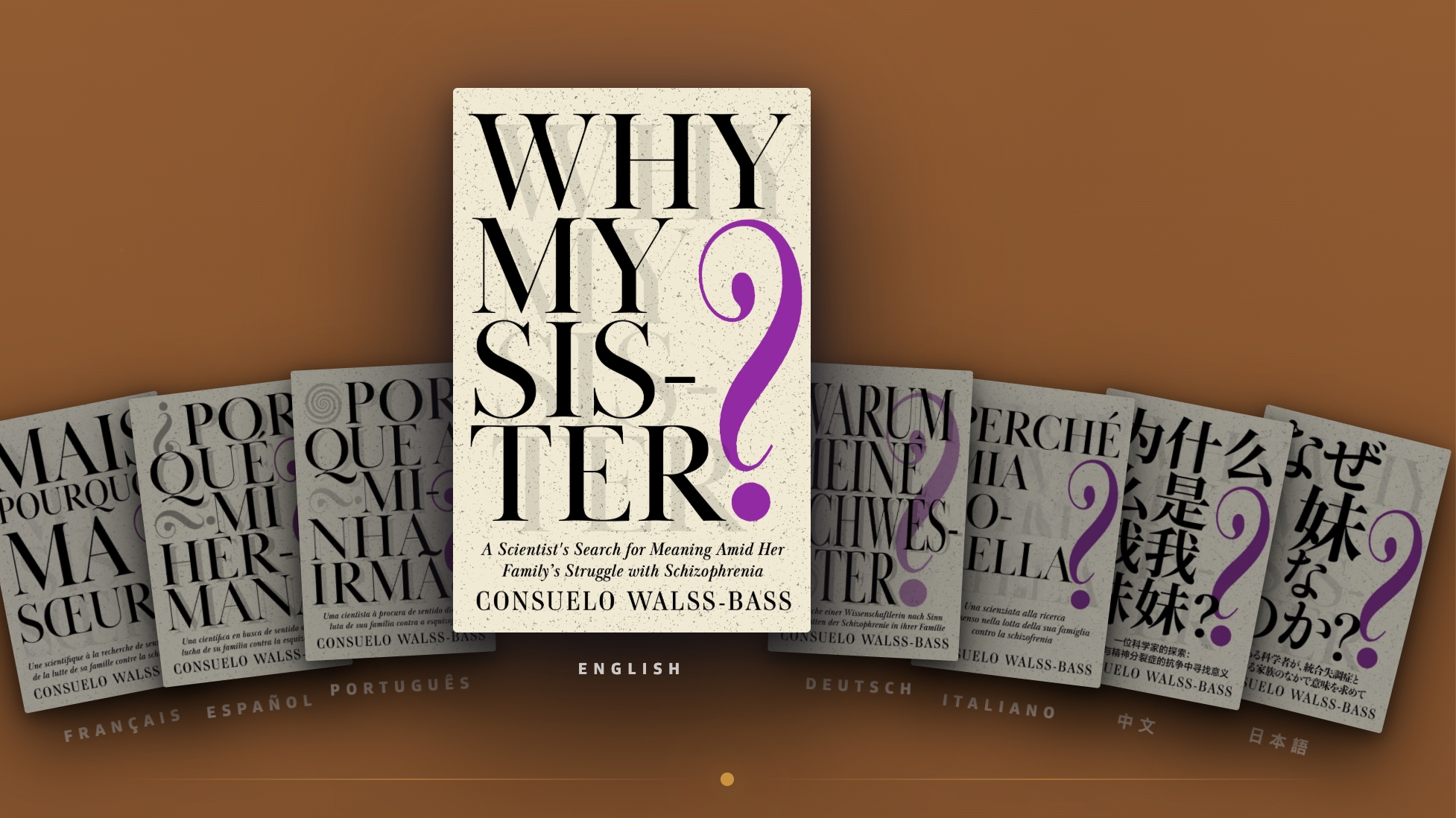
 Schizophrenia is 80% heritable, yet identical twins receive the same diagnosis less than half the time. Consuelo Walss-Bass, UTHealth Houston, has spent 30 years in that gap: her own family put her there.
Twin studies have placed the heritability of schizophrenia at roughly eighty percent for decades. Concordance between identical twins, who share the entire genome, does not reach fifty percent. Both figures are well established, and they do not fit together comfortably. Something that is not sequence variation accounts for the difference, and identifying it remains one of the open problems of psychiatric genetics.
The book that carries this question opens on an image. A young woman in a flowered dress is walking through an airport in Mexico City with three small children and no husband beside her. It is December 1976. She has just landed from Ohio, and her American visa will expire before Christmas, though she does not yet know it. Within months, when the money runs out and the visa does not come through, Eugenia will be living with her children, her disabled father, and her mother in a three-bedroom house in Puebla. A year later she will move them to her husband’s hometown, Torreón, and the voices in her head will come and go and come again. A fourth child will follow, a daughter named Patricia, called Paty. Paty will be called the pretty one. Paty will one day paint flowers, and the flowers will slowly stop looking like flowers. A fifth child, a son, arrives much later.
Consuelo Walss-Bass, Ph.D., is Eugenia’s third child and Paty’s older sister. She holds the John S. Dunn Foundation Distinguished Chair in Psychiatry at UTHealth Houston, where she directs the Psychiatric Genetics Program. Her mother’s schizophrenia went untreated across four decades and two countries. Of the five children, one received the same diagnosis. The number of affected siblings was close to what the statistics predict. Which sibling it would be was not predicted by anything the family could see, and was not explained by birth order or by the age at which each child was exposed to their mother’s illness. The youngest, a boy born long after the others, was spared. Paty was not.
Her laboratory addresses that question along two lines. She founded and directs the UTHealth Houston Brain Collection for Research in Psychiatric Disorders, which has received more than one hundred seventy-five donations since 2014 and supports transcriptomic profiling and epigenetic clock analysis of post-mortem tissue. Separately, her group generates induced pluripotent stem cells from donor skin biopsies and differentiates them into neurons and into three-dimensional cortical organoids, each smaller than a pea and each carrying the donor’s genome. Working from cells of affected sibling pairs in Costa Rica, her group was the first to demonstrate specific signaling alterations in neurons derived from people with schizophrenia, identifying convergent abnormalities in PI3K/GSK3 signaling. Drawing organoid lines from families with multiple affected members concentrates genetic signal that is diffuse across unrelated cases.
Why My Sister? runs in two registers. The family narrative, told in the third person, follows three generations between Mexico and the United States. Interleaved with it, set in a distinct typeface, are the scientific passages: positive and negative symptoms traced to Eugen Bleuler’s 1911 paper, the FKBP5 variants that modulate cortisol stress response and can either buffer a person against early adversity or sensitize them to it, the current state of stem cell modeling. The two lines can be read together or separately.
The book is candid about what has not been solved. Clozapine, the only medication that has fully stabilized the author’s sister, was discovered fifty years ago and remains the only option in treatment-resistant schizophrenia. It was withdrawn in 1976 after being incorrectly linked to eight deaths in Finland, re-approved in 1989 under a weekly blood monitoring requirement burdensome enough that many clinicians declined to prescribe it, and released from that requirement by the FDA in 2025. As the book went to press, Texas had not implemented the change. Two antipsychotics with novel mechanisms, Cobenfy and Caplyta, reached the market in the last two years, the first in decades to target something other than dopamine. The author does not present stem cell work as a cure. She presents it as a method by which a cure might become findable.
The book’s stated antagonist is stigma rather than the illness. Her older brother Rudy, a lawyer in Torreón, told her that the weight of societal stigma is crushing, that a person with cancer or diabetes receives empathy while a person with mental illness becomes the crazy one, and that this extends to everyone around them. Against that, the author repeats a plain sentence twice: Paty is doing well. Paty is fifty, lives above her sister’s garage, takes her medication, shops at the same store where the cashiers know her name, dresses for church on Sundays, and draws with her sister on Saturdays.
On the origin of the manuscript, Dr. Walss-Bass said: “I started writing this during COVID isolation. My father had moved in with us a couple of years before, after retiring. For the first time in my life, we really talked. He told me stories I had never heard.” On what the writing changed: “The more I wrote, the more I understood my mother. The lifetime of anger toward her slowly dissipated, giving way to empathy, compassion, and admiration for all that she endured.” On her sister: “I have always loved Paty, but now I am in awe of her.” On what she expects: “I firmly believe we will get there, and that my sons will see in their lifetimes a cure for schizophrenia.”