

Researchers report that anxiety about radiation worsened birth outcomes after the Fukushima nuclear accident
Fetal development is a critical stage with effects that can last throughout life. Yet, identifying the effects of maternal psychological stress on the fetus has been difficult, mainly because stressful events often produce psychological and physical consequences that directly affect mothers and their children. Natural disasters serve as important case studies to understand the impact of maternal psychological health on the growing fetus, but examining the isolated, specific impact of maternal psychological trauma on the child remains difficult.
To address this gap, Associate Professor Rong Fu from the Faculty of Commerce, Waseda University, Japan, and a Visiting Scholar at the Columbia Population Research Center, Columbia University, USA, along with Associate Professor Yunkyu Sohn of Seoul National University, Korea, Assistant Professor Yichen Shen of Kanagawa University of Human Services, Japan, and Professor Haruko Noguchi, also of Waseda University, examined a natural disaster that generated widespread anxiety far beyond its direct material impact: the Fukushima nuclear power plant accident that took place on March 15, 2011. The researchers studied the effects of maternal anxiety about radiation exposure on their fetus. Their findings were published online on March 7, 2026, and are scheduled to appear in Volume 107 of the Journal of Health Economics on May 1, 2026.
What motivated Fu to conduct this study? She explains, “Living and working in Japan, I witnessed firsthand how profoundly the Fukushima accident shook the public, particularly pregnant women and young mothers, even in regions far from any physical danger. Fukushima’s unique geography created a rare scientific opportunity to answer whether fear alone could harm a developing fetus.”
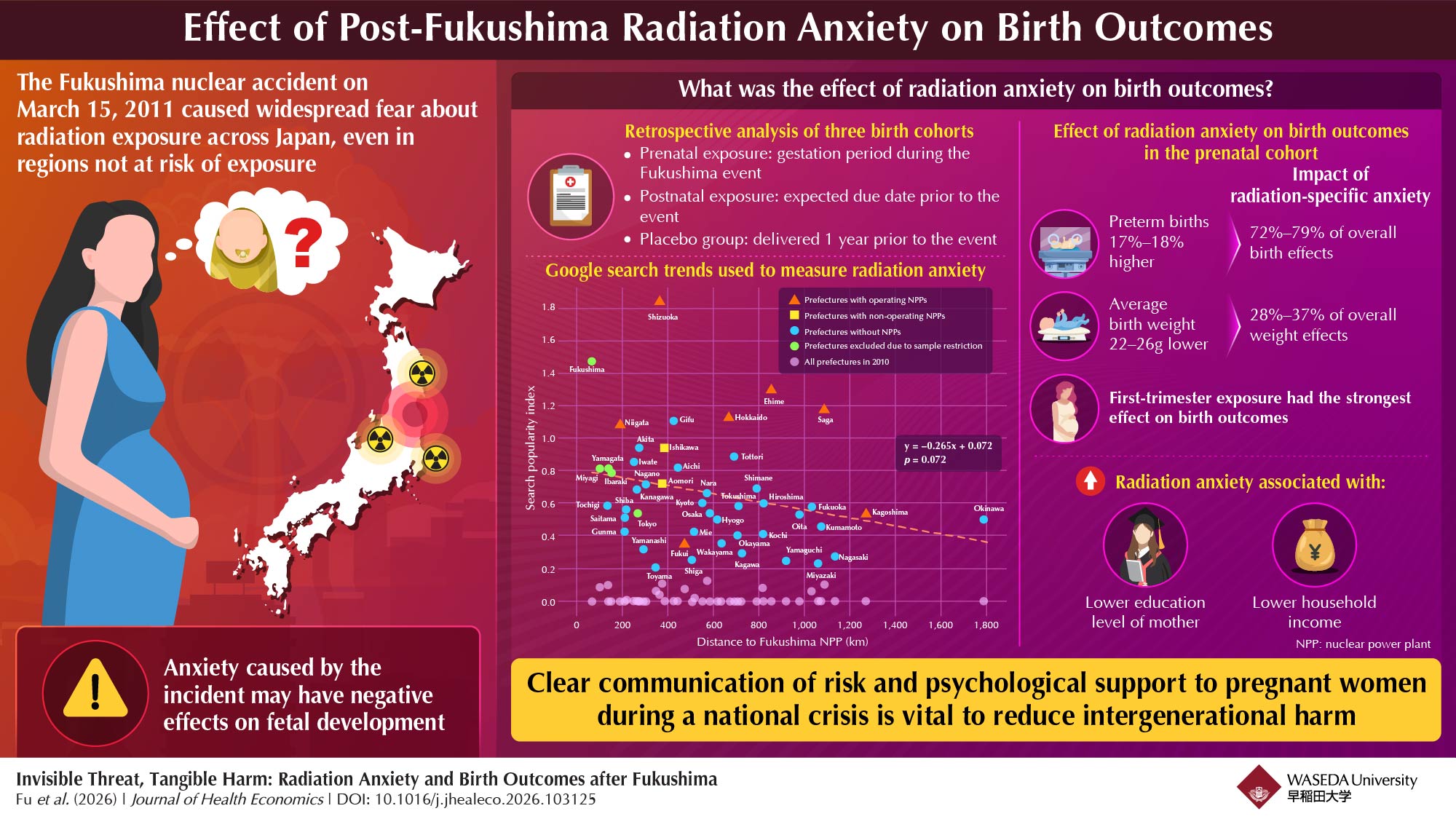
As part of the study, the team looked at three birth cohorts covering about 1.1 million births. The ‘prenatal’ exposure cohort consisted of babies who were in utero during the accident and were born afterward. The ‘postnatal’ exposure cohort included babies born before the accident. The ‘placebo’ cohort consisted of those born during the same period as the postnatal group but in the previous year. The researchers developed a novel measure of radiation anxiety using Google Trends data to examine whether birth outcomes deteriorated systematically as anxiety intensity increased across geographic areas.
They found that preterm births were 17–18% more common in the prenatal cohort than in the postnatal and placebo cohorts. Birth weights were 22 to 26 grams lower on an average. Rates of very low birth weight (VLBW) and extremely low birth weight (ELBW) were approximately 50% and 77% higher, respectively, compared to the other cohorts.
The researchers analyzed the differences in Google searches about nuclear power plants between March 12 and April 11, 2011, and compared to the same period in 2010 to create a Search Popularity Index (SPI) for each prefecture as a measure of radiation-specific anxiety. Regression analysis showed that radiation-specific anxiety accounted for 72–79% of the differences in preterm births and 28–37% of the differences in average birth weight between prenatal and other cohorts. Radiation anxiety played an even larger role in the differences in VLBW and ELBW rates. “Whether by triggering earlier delivery among at-risk fetuses or by intensifying growth restrictions in vulnerable populations, radiation-related psychological stress substantially increased the incidence of severe birth outcomes associated with elevated risks of lasting developmental challenges,” explains Fu.
Interestingly, the effects of radiation anxiety on birth outcomes were strongly tied to socioeconomic factors. Babies born to mothers with university degrees or to families in the top 25% income bracket were the least affected. “Higher education may offer advantages through better access to accurate information about radiation risks and stronger coping resources, while higher household income may enable access to private healthcare and greater flexibility in responding to perceived threats,” notes Fu.
Although population-level measures of anxiety are difficult to construct, the researchers say they were encouraged by the effectiveness of SPI as a proxy. They believe the same strategy can be used to measure the invisible psychological effects of other large-scale crises, including the COVID-19 pandemic and climate change.
Taken together, these findings highlight the effects that crisis-driven psychological stress can have on fetal development and birth outcomes. In addition to providing material support, disaster response protocols should prioritize clear communication that reduces fear and uncertainty. Psychological counseling should also be made available to pregnant women to help prevent intergenerational health consequences.
