

ALS is a disease where, in most cases, a protein forms aggregates in neurons, which leads to the rapid loss of motor control and death. A Nagoya University research team has discovered in human neuron cell cultures and mice an unexpected defense mechanism neurons switch on to avoid the aggregations, offering a new potential path to developing a treatment.
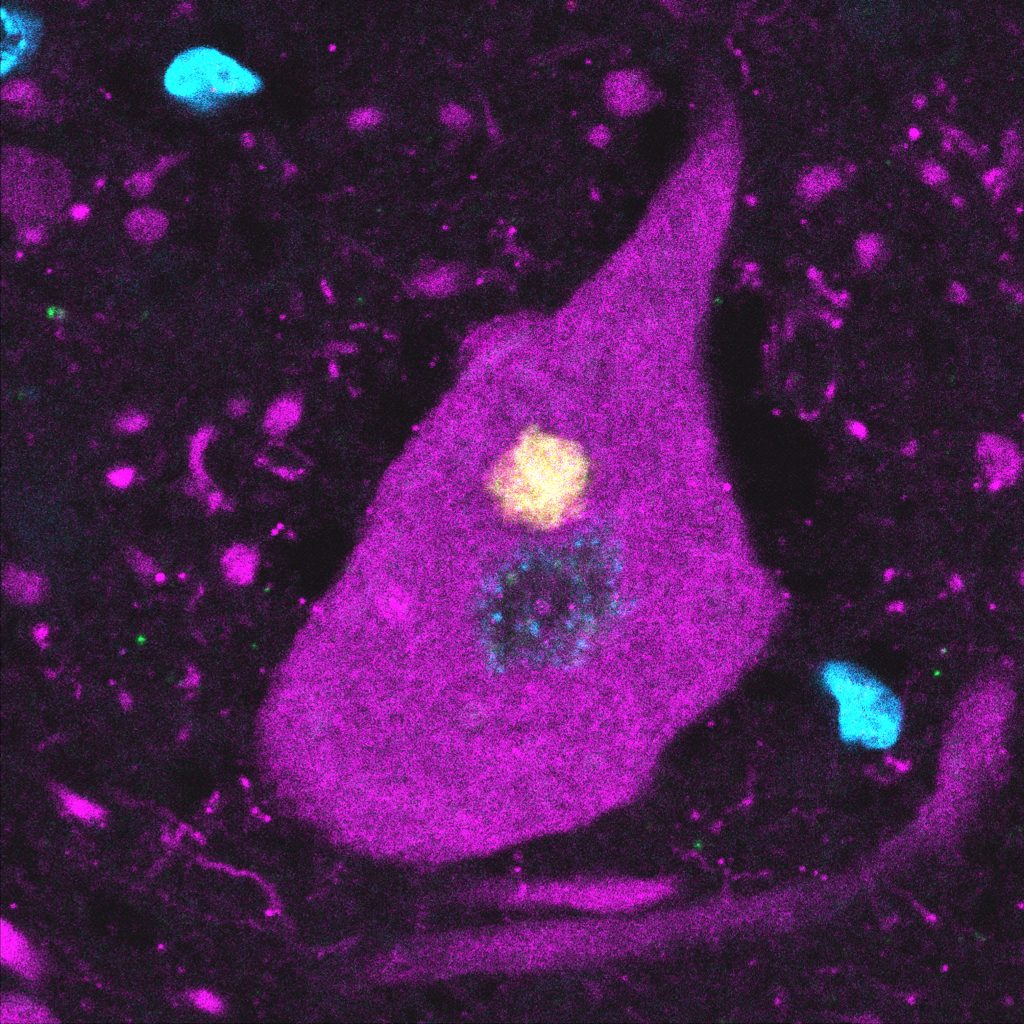
Amyotrophic lateral sclerosis (ALS) is a neurodegenerative disorder that affects roughly 10,000 people in Japan. It is characterized by a rapid loss of control over the limbs and other body parts and without a ventilator patients have a life expectancy of two to five years after onset. In most cases, a specific protein sits at the cause of the problem: TDP-43 is usually in the neuron’s nucleus and has various roles in maintaining the cell’s health and function. However, in people with ALS, it aggregates in the cells’ cytoplasm.
Nagoya University’s Koji Yamanaka and his group have been studying the role of TDP-43 for almost two decades. Yamanaka says: “Many people think that the problem starts when TDP-43 stops being transferred into the nucleus and accumulates in the cell’s cytoplasm. However, we could recently show that the protein, which usually operates in pairs or small groups, fails to form these groups under sudden stress; and so we think that the protein gets re-exported to the cytoplasm as some form of dysfunctional waste.” There, healthy cells usually remove such waste proteins, but the mechanism has not been understood well.
Shohei Sakai joined Nagoya University as a graduate student several years ago specifically to work with Yamanaka, driven to contribute to finding a cure after a case in his family. Now a project assistant professor, he explains: “It is usually thought that these faulty proteins are removed by a process called ‘autophagy,’ where they are collected in small vesicles and digested. But in my experiments, inhibiting this process did not inhibit the removal of TDP-43.”
The ensuing research has been published in the journal EMBO reports. In experiments on cultured neurons, including human stem cell-derived motor neurons, with supporting evidence from mice and patient tissue, the Nagoya group and their international collaborators found that motor neurons activate a protein-digesting machine called the “immunoproteasome” and traced the chain of events: Molecules of TDP-43 that have failed to pair up and have been exported into the cell’s cytoplasm physically interact with the sensor molecule “TBK1,” which is known to activate autophagy and also for mutations in its gene being a cause of inherited ALS. In their experiments, however, Yamanaka, Sakai and their team found that TBK1 also activates a signal mediated by “interferon beta” that can be perceived even by neighboring cells. Where this signal is received, neurons ramp up the production of the immunoproteasome, which then breaks down TDP-43 before it aggregates.
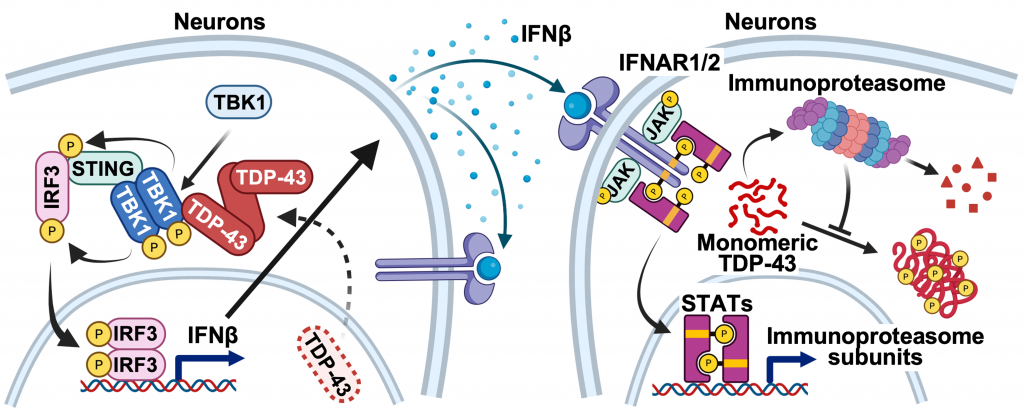
Importantly, the team also found that in the motor neurons from spinal cord samples donated by human ALS patients after death, the receptor for the signal was present in significantly lower quantities than in samples from people without ALS.
When asked why his team was able to discover this pathway, first author Sakai said: “TBK1 is known to activate autophagy and therefore many researchers focused on this process as the possible means of TDP-43 clearance. We don’t claim that this is not the case, but we think this may have masked the parallel activation of the immunoproteasome.”
“Moreover, it is impressive that the immunoproteasome exists in motor neurons,” added Yamanaka. Usually, this protein-digesting machine gets made in immune cells in response to viral infections, where it is used to disassemble virus components and display them on the cell’s surface. “This is a classical understanding of the immunoproteasome, but we found that motor neurons also have this system and ramp it up when they need to deal with abnormal proteins.”
The newly discovered pathway also offers a new route for developing a treatment approach. Yamanaka said: “In this pathway, the body uses interferon beta to activate the immunoproteasome and the signal molecule has in fact been used in treatments for other conditions. But because it triggers many different reactions, its severe side effects cannot be ignored.” Interferon beta, therefore, does not seem to be a practical treatment option for ALS. He continued, “In our next project, we aim to identify other compounds that can activate the immunoproteasome in motor neurons.” Sakai added: “We need to know the true therapeutic potential of this pathway. But I wish that this result encourages more people to study ALS and treatment options.”
