

UC Santa Cruz team achieves synthesis of beneficial neurochemical in just two steps, promising to break a bottleneck in drug development
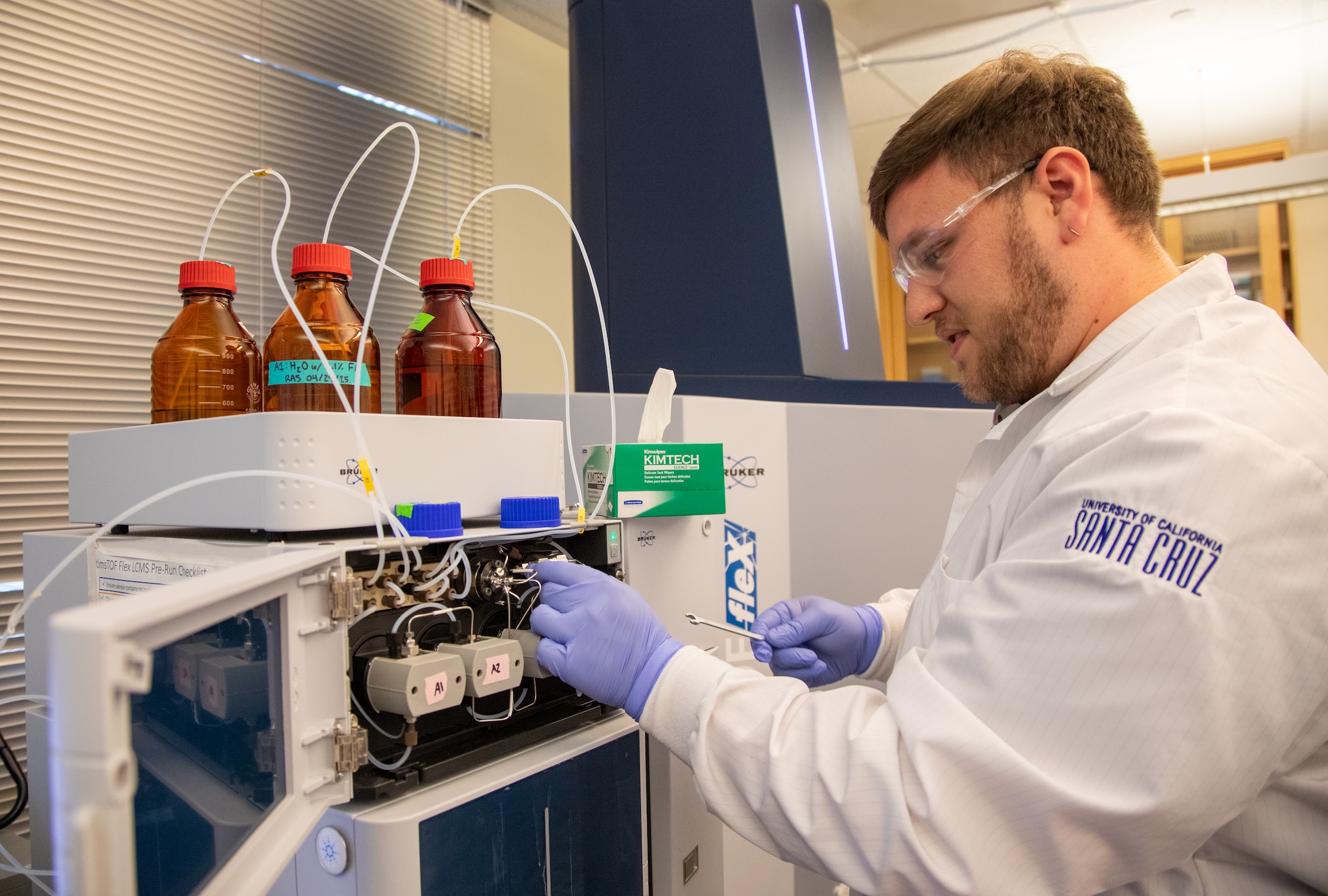
- Researchers at UC Santa Cruz developed a faster way to screen enzyme variants, helping scientists identify promising drug-making molecules much earlier and easing a major bottleneck in biocatalysis that has slowed pharmaceutical discovery for decades.
- The new method enhances mass spectrometry by capturing molecular shape, not just weight, allowing scientists to distinguish between molecules that weigh the same but behave very differently in the body—an essential capability for safe and effective drug development.
- Using this approach, the team streamlined production of the neurochemical kainic acid, reducing its synthesis from many complex chemical steps to just two, including a single enzyme-driven reaction inspired by seaweed biology.
A team of biochemists at the University of California, Santa Cruz, has developed a faster way to identify molecules in the lab that could lead to more effective pharmaceuticals. The discovery advances the rapidly growing field of biocatalysis, which depends on generating large, genetically diverse libraries of enzymes, and then screening those variants to find ones that perform a desired chemical task best.
This strategy has attracted major investment, particularly from drugmakers, because it promises quicker routes to complex, high-value molecules. However, traditional approaches to finding new biologically beneficial molecules often require “lots of shots on goal,” where researchers test enormous numbers of candidates through slow and inefficient workflows.
The method developed by the UC Santa Cruz team aims to significantly shorten that process by introducing smarter and faster decision-making tools that help researchers identify promising enzyme variants much earlier. They detail their new approach in the journal Cell Reports Physical Science.
Directed evolution and its bottleneck
A key concept underlying this work is directed evolution, a laboratory process that mimics natural selection. Scientists first create a large number of genetic variants of an enzyme. Then, they screen those variants to see which ones perform the desired chemistry, retain the best candidates, and repeat the cycle. Over multiple rounds, enzymes can be “evolved” to carry out reactions that are new to nature.
However, directed evolution faces a persistent bottleneck: screening. While generating thousands—or even tens of thousands—of enzyme variants is relatively straightforward, analyzing the chemical products they make has long been the rate-limiting step.
“Our versatile analytical platform provides a roadmap for accelerating the discovery of enzymes that are capable of carrying out unique chemical reactions at scale,” said study co-author Laura Sanchez, professor of chemistry and biochemistry. This platform will help democratize screening mutant libraries at scale for drug discovery.
Mass spectrometry: powerful but limited
In biocatalysis, the standard screening tool is mass spectrometry, often described by those in the field as “the world’s most expensive balance.” The technique measures the precise mass of molecules based on their elemental composition, allowing researchers to identify chemical formulas with extraordinary accuracy.
However, mass spectrometry has a critical limitation. Some molecules have the same mass but differ in their three-dimensional arrangement, a property known as chirality or “handedness.” Much like left and right hands, these mirror-image molecules weigh the same but can behave very differently in biological systems. Traditional mass spectrometry struggles to distinguish between them.
The approach developed at UC Santa Cruz overcomes that challenge by incorporating information about molecular shape and size, not just mass. This makes it possible to rapidly distinguish molecules that are chemically identical in weight but different in their 3D structure—a crucial distinction for drug development.
Synthesizing seaweed neurochemicals
In their paper, the team focused on a molecule found naturally in certain seaweeds: kainic acid, which has played an important role in neuropharmacology because it selectively activates a subset of receptors in the brain. Although humans do not produce kainic acid themselves, researchers discovered decades ago that administering it—primarily in animal models such as mice and rats—could be used as a tool to study brain function and disease.
For a period of time, particularly in the 1990s and early 2000s, injecting kainic acid into mice was a common way to model epileptic seizures in the laboratory. This allowed scientists to observe physiological responses and gain insights into how glutamate receptors contribute to neurological disorders.
But isolating kainic acid directly from seaweed is neither scalable nor sustainable. In fact, heavy reliance on natural extraction in earlier decades led to concerns that global supplies of the relevant seaweed were being depleted.
Synthetic chemistry has offered many alternative routes—more than 70 distinct synthetic strategies have been reported for making kainic acid. However, none of these routes are particularly efficient. The shortest syntheses still require multiple steps, often at least six, and scalable approaches suitable for producing gram-scale quantities typically involve 10 or 11 steps.
By contrast, the enzymatic approach—first established at UC San Diego’s Scripps Institution of Oceanography and advanced at UC Santa Cruz—can produce kainic acid in just two steps: one conventional chemical step to prepare a precursor, followed by a single enzyme-catalyzed reaction that “snaps” the molecule into its ring structure.
“This is a really powerful enzyme family that takes relatively simple starting materials and does selective chemistry on them,” said study co-author Shaun McKinnie, associate professor of chemistry and biochemistry at UC Santa Cruz. “Developing additional screening tools to help us better understand how they react will allow us to better apply them for the efficient production of other new neurochemicals.”
Collaborative chemistry led by students
This discovery stemmed from the integration of different specialities. The Sanchez Lab brought deep experience in advanced mass spectrometry. The McKinnie Lab brought expertise in enzyme discovery and organic chemistry. By integrating fast mass spectrometric screening with approaches that retain three-dimensional structural information, the team aimed to solve a problem that had long constrained the field.
Graduate student Robert Shepherd, the paper’s lead author, said what felt most rewarding was the opportunity to team up with amazing scientists to tackle a demanding interdisciplinary challenge. “Everyone involved has brought their passion and expertise to the bench from the very beginning, and this project serves as an excellent reminder that science, unlike mass spectrometry, does not occur in a vacuum,” Shepherd said. “It has been an absolute pleasure working in such a collaborative, interdisciplinary research environment.”
Other members of the team included postdoctoral researcher Manasa Ramachandra, several other graduate students now completing their Ph.D.s, and undergraduates supported by the Science Division’s STEM diversity programs. The work was primarily funded by the National Institutes of Health, through an R21 grant designed to foster high-risk, high-reward ideas at a conceptual stage.
