

More than 8 in 10 U.S. adults know that preventing mosquito bites and controlling mosquitoes in and around the home is the best defense against mosquito-borne diseases such as West Nile virus and dengue fever, but far fewer know how to correctly apply or choose insect repellent, according to a new nationally representative survey from the Annenberg Public Policy Center (APPC) of the University of Pennsylvania.
The Annenberg Science and Public Health (ASAPH) survey, which was conducted Aug. 4-17, 2026, among 1,904 empaneled U.S. adults, finds that 82% correctly say the best defense against dengue fever and West Nile virus is preventing mosquito bites and controlling mosquitoes in and around the home. Nearly two-thirds (64%) say they routinely take precautions to avoid mosquito bites, with many of those saying they routinely take precautions such as removing standing water, using insect repellent, wearing long-sleeved shirts or other protective clothing outdoors, routinely replacing or repairing window screens, or avoiding activities or areas that would bring them in contact with mosquitoes.
Generally, knowledge about the proper use of insect repellent remains much lower. About a third of all respondents know that when using sunscreen and insect repellent together, the Centers for Disease Control and Prevention (CDC) recommends applying sunscreen first, letting it dry, and then applying insect repellent; nearly half are unsure in which order to apply them. Less than a fifth know that insect repellent should not be applied to skin under clothing (15%) or know to look for an EPA-registered repellent (18%).
“The CDC needs to do a better job of informing the public about how to choose and apply insect repellent,” said Patrick E. Jamieson, director of APPC’s Annenberg Health and Risk Communication Institute, which oversees the health survey.
The findings come as mosquito-borne diseases remain a public health concern. West Nile virus is the leading cause of mosquito-borne disease in the continental United States, according to the CDC, and dengue is also spread through the bites of infected mosquitoes. Though significantly lower than the number of reported cases at this time in 2025, as of Sept. 8, 2026, the CDC had reported 504 human cases of West Nile virus across 41 states through ArboNET, a national CDC surveillance system, including 363 cases of the more serious neuroinvasive disease. Despite that risk, just 16% of U.S. adults say they are worried that they or someone in their family will contract dengue fever or West Nile virus in the next three months.
“Despite the drop in the number of West Nile Virus cases relative to 2025, taking precautions to prevent mosquito bites and control mosquitoes is important to uphold community public health,” said Ken Winneg, APPC’s managing director of survey research.
Most know preventing mosquito bites is the best defense
There is considerably greater public knowledge about how to protect against mosquito-borne diseases.
More than 8 in 10 U.S. adults (82%) know that the best defense against dengue fever and West Nile virus is preventing mosquito bites and controlling mosquitoes in and around the home. That is essentially unchanged from 81% in 2025 and 79% in 2024.
The CDC recommends using insect repellent, wearing loose-fitting long-sleeved shirts and pants, taking steps to control mosquitoes indoors and outdoors, and eliminating standing water where mosquitoes can lay eggs.
Nearly two-thirds routinely take precautions against mosquito bites
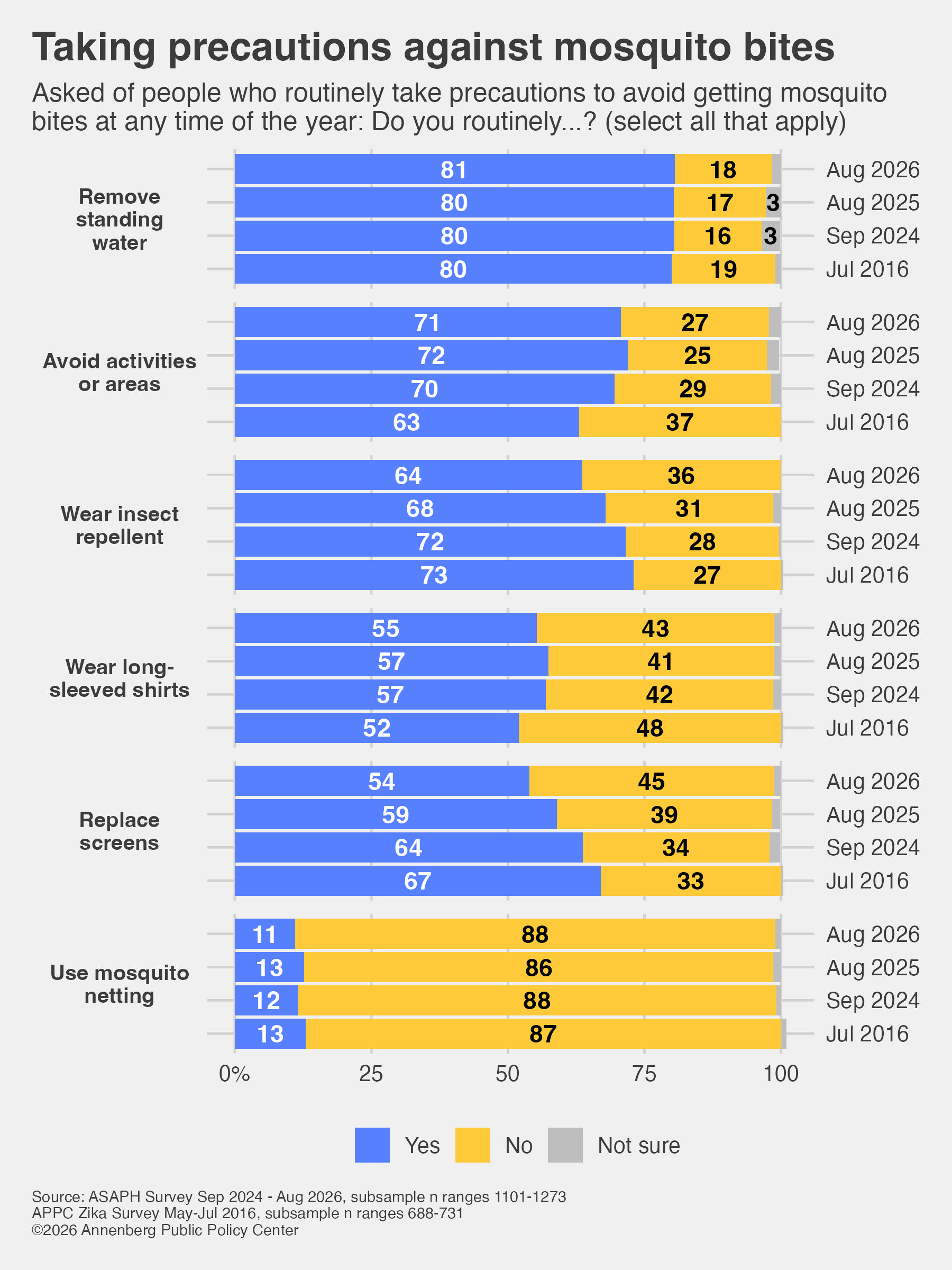
The survey finds that 64% of Americans say they routinely take precautions to avoid mosquito bites, compared with 61% in August 2025 and 59% in September 2024. Although there has been an increase since 2024, the current finding is consistent with responses from July 2016, during the U.S. outbreak of mosquito-borne Zika virus, when 67% said they routinely took precautions as well.
Among those taking precautions, the current survey finds that:
- 81% say they routinely remove standing water;
- 71% avoid activities or areas that would bring them into contact with mosquitoes, unchanged from the past two years, but significantly higher compared to July 2016 (63%);
- 64% wear insect repellent, statistically unchanged from 2025, significantly lower than the 72% saying they did so in September 2024 and 73% in July 2016;
- 55% wear long-sleeved shirts or other protective clothing outdoors;
- 54% replace or repair window screens, much lower than reported in September 2024 (64%) and July 2016 (67%);
- 11% use mosquito netting, no change going back to July 2016.
Knowledge about using insect repellent remains low
As in 2025, many Americans remain uncertain about the proper use of insect repellent. When asked about applying sunscreen and insect repellent together, 31% correctly say the CDC recommends putting on sunscreen first, letting it dry, and then applying insect repellent. Nearly half (49%) are unsure. The percentage answering correctly is statistically unchanged from 33% in 2025.
Knowledge is even lower about applying insect repellent beneath clothing. Just 15% correctly say that the CDC recommends not putting insect repellent under clothing, essentially unchanged from 14% in 2025. Four in 10 (41%) are unsure.
Most adults (53%) correctly know that insect repellent should not be used on babies younger than 2 months old, statistically unchanged from 54% in 2025. Another 42% are unsure.
Few know to look for an EPA-registered repellent
The survey finds continuing uncertainty about how to choose an insect repellent. Only 18% correctly identify the CDC recommendation to look for a repellent that says it is EPA registered, compared with 19% in 2025. Nearly half (45%) are unsure, while 30% incorrectly choose a repellent containing more than 50% DEET and 6% choose one described as “natural.”
The CDC recommends EPA-registered insect repellents with active ingredients such as DEET, picaridin, IR3535, oil of lemon eucalyptus, para-menthane-diol, or 2-undecanone. The CDC guidance notes that concentrations above 50% DEET generally do not provide additional protection against mosquito bites.
Worry about West Nile and dengue remains low
Despite continuing concern among public health officials about mosquito-borne disease, the share of Americans worried about contracting West Nile virus or dengue has barely changed over the past two years.
In August 2026, 16% say they are worried that they or someone in their family will contract one of the diseases during the next three months. That compares with 15% who were worried in August 2025 and 15% in September 2024.
The CDC describes West Nile virus as the leading cause of mosquito-borne disease in the continental United States. People most commonly become infected through the bite of an infected mosquito. Most people who are infected do not develop symptoms, although some develop febrile illness and a small proportion develop serious disease affecting the central nervous system.
Fewer Americans recognize symptoms of West Nile
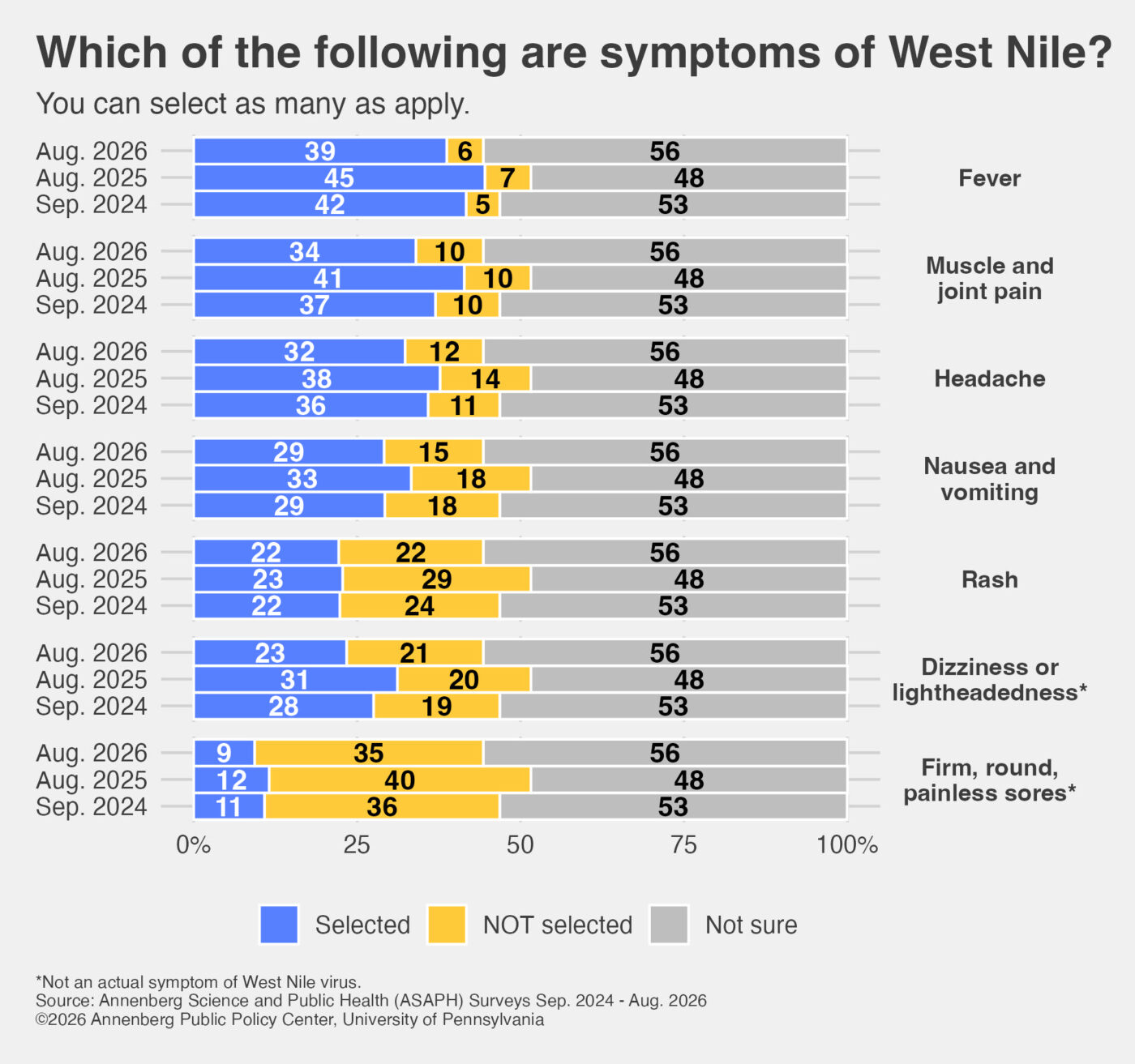
Although worry about contracting West Nile or dengue has remained stable, knowledge of the symptoms of West Nile virus has fallen. When respondents are presented with a list of possible symptoms, 56% say they are unsure which were symptoms of West Nile, an 8-percentage-point increase from 48% in August 2025 and statistically unchanged from the 53% recorded in September 2024. As in 2025, “fever” was selected by more adults as a symptom of West Nile virus, but significantly fewer than last year (39% vs. 45%). Similar patterns are seen with other symptoms relative to 2025:
- 34% selected “muscle and joint pain” a 7-point drop from the 41% who selected it in 2025; 32% selected “headache” a significant drop of six percentage points from 2025 (38%);
- 29% selected “nausea and vomiting,” a 4-point drop from 2025 (33%), but not statistically different.
- No change was seen in the percentage who selected “rash” (22% in 2026 vs. 23% in 2025).
- Two symptoms, incorrectly selected, were “dizziness or lightheadedness” and “firm, round painless sores.” Fewer incorrectly selected “dizziness” in 2026 (23%) than in 2025 (31%). Roughly the same proportion selected “firm, round painless sores” in 2026 (9%) as in 2025 (12%).